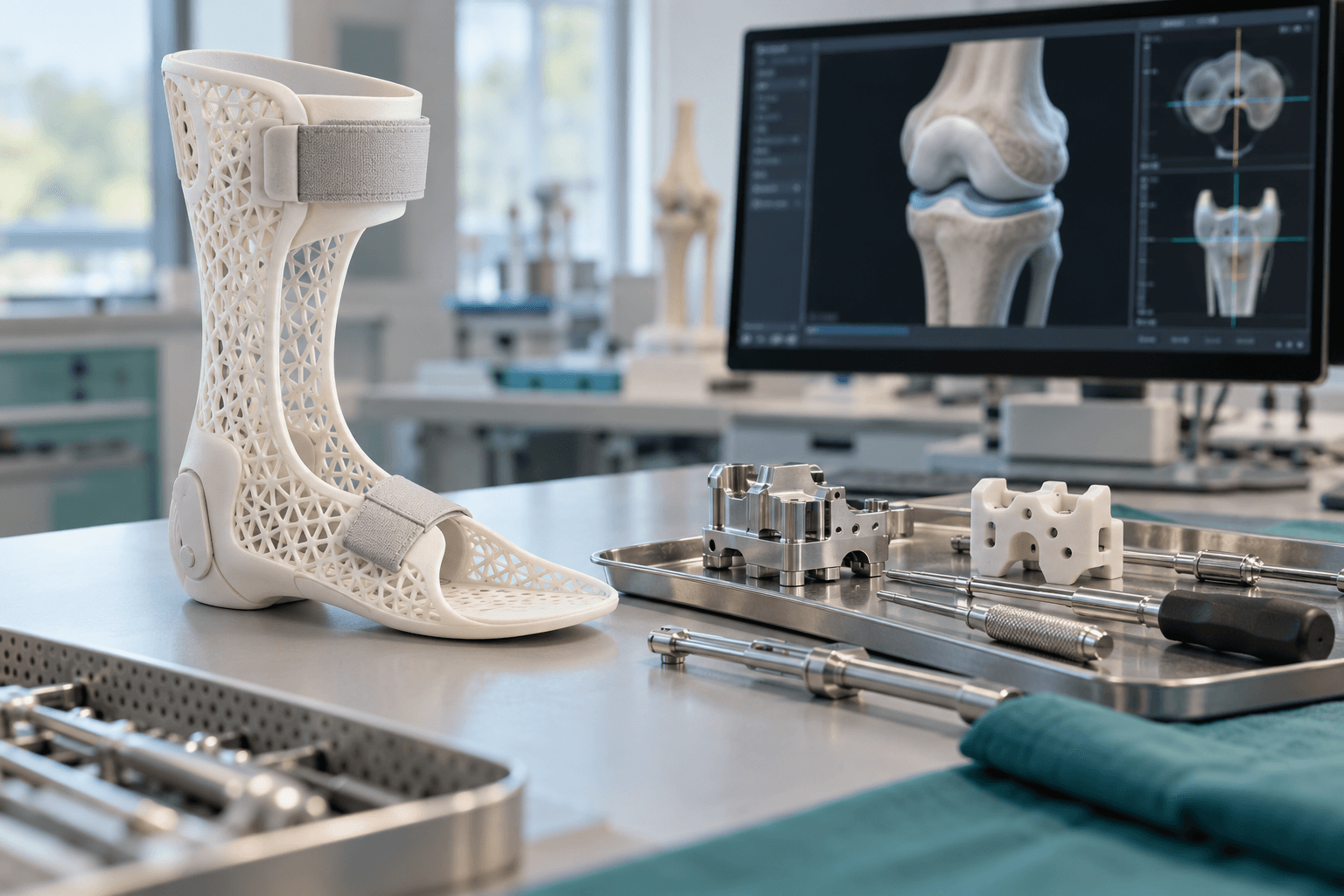
Some orthopaedic procedures now use technologies alongside conventional manual sets, including computer-assisted navigation, robotic assistance, patient-specific guides, intraoperative sensors, augmented reality, and 3D-printed models or devices. These tools serve different purposes: navigation and robotics can assist surgical execution, while patient-specific guides and 3D-printed models support planning for an individual case. Orthotic devices address another need: fitting and mobility support.
Robotics and navigation: precision is only one measure
A 2026 review of total knee arthroplasty technology describes navigation and robotic systems alongside patient-specific instruments, sensors, and digital tools. The authors report that some technologies can improve accuracy and intraoperative decision-making, while long-term clinical superiority and cost-effectiveness remain unestablished for many of them. See “Enabling technology in total knee arthroplasty: current concepts in 2026”.
The choice of a platform also affects procurement. The American Academy of Orthopaedic Surgeons' U.S.-focused 2026 discussion of implant-agnostic robotic systems notes that many systems connect the robot, planning software, instruments, and implant portfolio. A facility should therefore check supported implants, disposable components, software and service costs, training, infrastructure, and whether it can continue using other systems. Greater technical precision alone does not settle the clinical or economic case.
Patient-specific guides and 3D printing
Patient-specific instruments are designed for a particular case or anatomy and can require imaging, planning, design approval, manufacture, delivery, and a defined sterile-use pathway. Buyers should ask who is responsible for each step, how the guide is identified and checked, what happens if the plan changes, and whether it is single-use or reusable. The facility should follow the manufacturer's instructions and its own validated procedures.
Katalemwa Cheshire Home recently said 3D printing is emerging at its Assistive Technology Centre and reported hands-on training for its technical staff. Its announcement mentions ankle-foot orthoses, knee-ankle-foot orthoses, and prosthetic sockets. The announcement describes development and training; it does not establish the scale of production or routine availability. This is distinct from robotic joint-replacement systems. For either type of technology, staff skills, fitting, maintenance, and workflow need to be considered alongside equipment.
Questions to ask before adopting a new system
Does it address a documented service need? What evidence supports the intended use? Which implants and instruments are compatible? What training, consumables, maintenance, software, and technical support are required? What is the cost over the expected service life? What regulatory documents apply to the exact device and configuration?
Uganda's Ministry of Health equipment guidelines call for planning, user training, quality assurance, maintenance, and lifecycle management as part of acquisition. Compare each system with the facility's existing instruments, service capacity, and budget.
For orthopaedic products, Maurivik Uganda can help identify the product and documentation relevant to an enquiry. Availability, compatibility, and regulatory status should be checked for the exact model; this article is general procurement information, not clinical advice.
This article is general information. Product status can change; check current manufacturer documents and regulator records for the specific product.
Ask about a product